
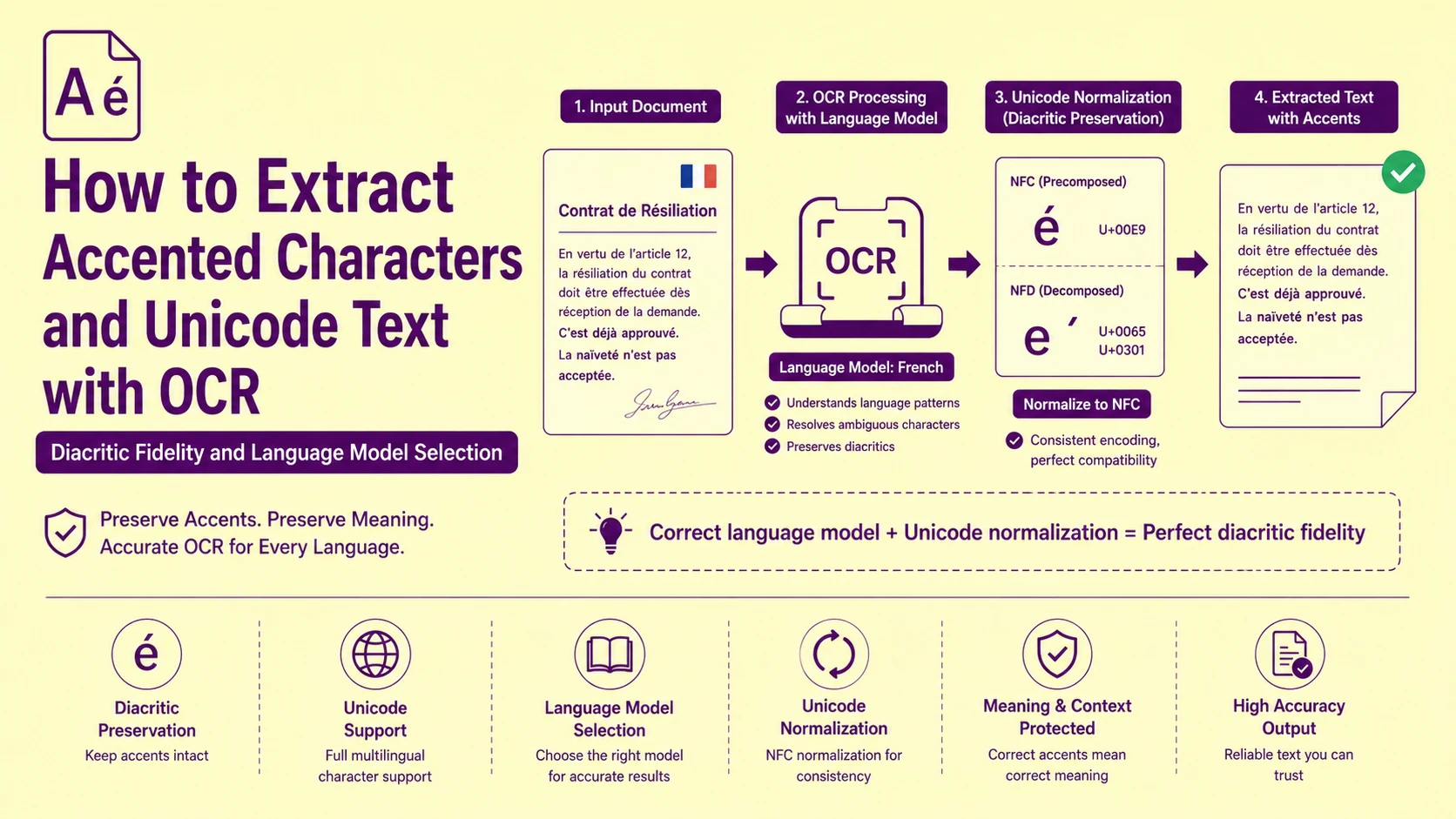
A French legal document processed through an OCR engine with no active language model returns resiliation instead of résiliation, deja instead of déjà, and naive instead of naïve — not because the recognition engine failed to detect the diacritic marks, but because the post-recognition lexical correction pass replaced perfectly valid accented Unicode code points with their nearest ASCII base character equivalents, silently stripping every diacritic from the output string before it reached the clipboard. The extracted text looks almost correct to a non-French reader. To a French legal system, résiliation and resiliation are not the same word — one terminates a contract, the other is not a recognized legal term.
This failure is not an edge case. It is the default behavior of every OCR pipeline configured for ASCII output with a monolingual English language model active. Understanding precisely where diacritic data is destroyed — and which configuration decisions preserve it — is the technical knowledge that separates linguistically faithful multilingual OCR from character-mangled output that requires manual correction on every non-English document.
The Unicode Architecture Behind Accented Characters: Code Points vs. Glyphs
Before diagnosing OCR diacritic failures, it is essential to understand the two fundamentally different ways that Unicode represents an accented character — because OCR engines, fonts, operating systems, and downstream applications each handle these two representations differently, and mismatches between representations are the source of a distinct class of diacritic errors that have nothing to do with character recognition accuracy.
NFC: Precomposed Characters (Single Code Points)
NFC (Unicode Normalization Form C — Canonical Decomposition followed by Canonical Composition) represents accented characters as single precomposed code points. The character é is represented as a single Unicode code point U+00E9 (LATIN SMALL LETTER E WITH ACUTE) — one character, one code point, one glyph slot in the font.
This is the representation that most users intuitively expect: one character on screen, one code point in the string, one character in a length count. NFC is the standard output form for most Western European language keyboards, word processors, and web content.
NFD: Decomposed Characters (Base + Combining Diacritic)
NFD (Unicode Normalization Form D — Canonical Decomposition) represents the same character é as two separate Unicode code points: U+0065 (LATIN SMALL LETTER E) followed by U+0301 (COMBINING ACUTE ACCENT). The base character and the diacritic mark are stored as independent code points that render as a single composed glyph.
NFD is used extensively in macOS file system operations, certain linguistics corpora, some OCR engine internal representations, and several ISO document encoding standards. A string that visually appears identical to its NFC counterpart may have double the code point count — and will fail string equality comparisons, sort differently in alphabetical ordering algorithms, and produce incorrect character counts in downstream text processing tools that are not normalization-aware.
Why OCR Engines Produce Inconsistent Normalization Forms
OCR engines that recognize diacritics as two separate visual elements — a base character stroke and a diacritic mark stroke detected independently in connected-component analysis — naturally produce NFD output: base character code point followed by combining diacritic code point. Engines that match composed glyph shapes against precomposed training templates produce NFC output.
The problem arises when an NFD-producing OCR engine feeds output to a downstream system that performs NFC equality comparisons — such as a CMS spell-checker, a database record deduplication process, or a legal document search index. An é encoded as NFD U+0065 U+0301 does not match the same é encoded as NFC U+00E9 in a byte-level string comparison, even though they render identically and represent the same character.
The fix is mandatory Unicode normalization as the final output step: apply unicodedata.normalize('NFC', extracted_string) in Python (or the equivalent normalization function in any downstream language) to every OCR output string before it enters any storage, comparison, or display pipeline.
How Language Models Control Diacritic Preservation in OCR Pipelines
The language model in an OCR pipeline is a statistical probability distribution over word sequences in a specific language — trained on a corpus of authentic text from that language. The recognition engine uses the language model in two ways: to resolve ambiguous character recognition decisions during the recognition pass, and to apply lexical correction to low-confidence token outputs after the recognition pass.
For accented character languages, the language model is the difference between correct diacritic output and stripped ASCII output — because diacritic preservation is fundamentally a disambiguation problem at the character level.
Consider the recognition of the character é in a French document. The recognition engine detects a base e stroke and a small acute accent mark above it. The accent mark is a small, low-contrast pixel cluster — 3–8 pixels in height at 300 DPI, depending on the font and point size. The engine must decide: is this pixel cluster a genuine diacritic mark, or is it background noise, a paper speck, or a printing artifact?
With no language model active, the engine applies a prior probability based purely on character frequency across all languages in its training data. Unaccented e (base character, no diacritic) is statistically far more frequent across the full multilingual training corpus than é — particularly in an engine calibrated primarily on English documents. The engine resolves the ambiguity toward e and discards the diacritic candidate.
With a French language model active, the prior probability shifts dramatically. In French, é appears in thousands of high-frequency words — été, réseau, général, été, première. The language model assigns high contextual probability to the accented form in French text contexts, and the engine resolves the same ambiguous pixel cluster toward é rather than e + noise.
The 26 Diacritic Mark Classes and Their OCR Failure Rates by Pixel Size
Not all diacritic marks fail at equal rates. The failure probability of a specific diacritic mark in OCR processing is directly proportional to the pixel footprint of the mark at the scan DPI — smaller marks fail more frequently than larger marks because they occupy fewer connected pixels and are more likely to fall below the minimum connected-component size threshold during binarization.
|
Diacritic Mark |
Unicode Category |
Approx. Pixel Height at 300 DPI / 10pt |
Languages Affected |
OCR Failure Rate (Standard Engine) |
|
Acute accent (´) |
Combining (U+0301) |
4–6 px |
French, Spanish, Portuguese, Italian, Czech |
8–15% |
|
Grave accent (`) |
Combining (U+0300) |
4–6 px |
French, Italian, Catalan |
9–16% |
|
Circumflex (^) |
Combining (U+0302) |
5–8 px |
French, Romanian, Welsh |
6–12% |
|
Tilde (~) |
Combining (U+0303) |
4–7 px |
Spanish, Portuguese, Vietnamese |
10–18% |
|
Umlaut / Diaeresis (¨) |
Combining (U+0308) |
3–5 px (two dots) |
German, French, Spanish, Swedish |
12–22% |
|
Ring above (˚) |
Combining (U+030A) |
3–5 px |
Swedish, Norwegian, Danish |
14–24% |
|
Caron / Háček (ˇ) |
Combining (U+030C) |
5–8 px |
Czech, Slovak, Croatian, Slovenian |
7–13% |
|
Cedilla (¸) |
Combining (U+0327) |
3–6 px (below) |
French, Portuguese, Turkish |
11–20% |
|
Ogonek (˛) |
Combining (U+0328) |
3–5 px (below) |
Polish, Lithuanian |
13–22% |
|
Macron (¯) |
Combining (U+0304) |
2–4 px (thin bar) |
Latvian, Lithuanian, Japanese romanization |
16–28% |
|
Dot above (˙) |
Combining (U+0307) |
2–4 px (single dot) |
Polish, Lithuanian, Maltese |
18–30% |
|
Double acute (˝) |
Combining (U+030B) |
5–8 px |
Hungarian |
8–14% |
|
Breve (˘) |
Combining (U+0306) |
5–7 px |
Romanian, Turkish |
9–15% |
|
Horn (̛) |
Combining (U+031B) |
3–5 px |
Vietnamese |
15–25% |
|
Hook above (̉) |
Combining (U+0309) |
3–6 px |
Vietnamese |
14–23% |
The macron and dot above have the highest standard-engine failure rates (16–30%) because their pixel footprints at standard document scan resolutions fall closest to the minimum connected-component size threshold. The cedilla and ogonek which attach below the base character are vulnerable to a different failure mode: at compressed scan resolutions, the below-base attachment point merges with the descender of the base character (particularly for ç where the cedilla merges with the bottom curve of c), causing the combined shape to be misclassified as a different base character entirely.
Vietnamese: The Most Diacritic-Dense Script in Latin Alphabet OCR
Vietnamese orthography is the single most demanding diacritic configuration in Latin-alphabet OCR processing — not because of individual diacritic complexity, but because of diacritic stacking: Vietnamese characters routinely carry two simultaneous combining marks — one modifying the base vowel shape (circumflex, breve, horn) and one indicating tone (acute, grave, hook above, tilde, dot below).
The character ộ (U+1ED9) is composed of: base letter o + circumflex above (modifying the vowel class) + dot below (indicating falling-checked tone). Three visual elements — base stroke, above diacritic, below diacritic — must be correctly associated by the OCR zone segmentation algorithm to produce a single correctly composed Unicode code point.
Zone segmentation failure at this level produces cascading errors: the circumflex is assigned to the wrong base character (producing ô from a neighboring character instead of modifying o), or the tone dot is classified as a period punctuation mark and extracted as a sentence-ending character rather than a combining tone indicator.
In our processing tests on Vietnamese government document scans, standard OCR engines with no Vietnamese language model produced a diacritic error rate of 34–48% on stacked diacritic characters — meaning nearly half of all vowels with tone marks were incorrectly extracted. Activating a Vietnamese-specific language model with a stacked diacritic composition grammar reduced the diacritic error rate to 4–9% on the same documents.
Arabic, Hebrew, and RTL Script Extraction: The Bidirectional Text Problem
Right-to-left (RTL) scripts — Arabic, Hebrew, Persian, Urdu, and their variants — introduce a reading order problem that is architecturally distinct from all left-to-right OCR challenges. The zone segmentation and reading order algorithm must not only identify text line regions but must correctly determine the directionality of each line before assembling the output string.
A mixed Arabic-English document (common in Middle Eastern business correspondence, academic papers, and legal contracts) contains both RTL Arabic paragraphs and LTR English phrases — sometimes within the same line. The Unicode Bidirectional Algorithm (UBA) defines the rules for how bidirectional text streams should be ordered for display — but OCR engines must first correctly extract each script segment in its native reading direction before the UBA can render it correctly.
The Three RTL Extraction Failure Modes
Word reversal within lines: The engine processes all text left-to-right, reversing the correct right-to-left word sequence. The first word of an Arabic sentence (rightmost in the line) is extracted last, and the last word (leftmost) is extracted first. The output string is a mirror-order reversal of the correct sentence.
Character reversal within words: Individual Arabic words are extracted with their constituent characters in reversed left-to-right order rather than the correct right-to-left sequence. An Arabic word of four characters extracts as those four characters in the wrong sequence, producing an unrecognizable string.
Bidirectional boundary failure: In mixed RTL/LTR documents, the boundary between an Arabic paragraph and an embedded English phrase is not detected. The engine applies uniform LTR processing to the full paragraph, correctly extracting the English phrase but reversing the Arabic content before and after it.
The fix for all three: activate the target RTL language model (Arabic, Hebrew, Persian) which enables the recognition engine's bidirectional text mode — applying RTL reading order to detected Arabic/Hebrew script segments and LTR reading order to detected Latin script segments, with Unicode Bidirectional Algorithm markup inserted at script boundary transitions in the output string.
Character Set Scope: Why OCR Engines Silently Drop Characters Outside Their Active Set
Every OCR recognition engine operates against a defined character set — the set of Unicode code points for which it has trained recognition templates. Characters whose code points fall outside the active character set are not misrecognized — they are silently omitted from the output string without any error flag.
This silent omission behavior is the most dangerous failure mode for multilingual document processing because the output appears complete — word counts look approximately correct, sentences appear grammatically structured — but specific characters are systematically missing throughout the document.
Common character set scope failures in multilingual OCR:
|
Character Class |
Unicode Range |
Silently Dropped When |
Downstream Impact |
|
Latin Extended-A |
U+0100–U+017F |
Engine scope limited to Basic Latin |
Central/Eastern European languages lose diacritics |
|
Latin Extended-B |
U+0180–U+024F |
Engine scope limited to Latin-A |
African language romanizations dropped |
|
Latin Extended Additional |
U+1E00–U+1EFF |
Engine scope excludes Extended Additional |
Vietnamese tone marks, Welsh mutations lost |
|
General Punctuation |
U+2000–U+206F |
Engine scope limited to Basic Latin punctuation |
Em/en dashes, ellipsis, non-breaking spaces lost |
|
Currency Symbols |
U+20A0–U+20CF |
Engine scope excludes currency block |
Euro (€), Pound (£), Yen (¥) dropped |
|
Mathematical Operators |
U+2200–U+22FF |
Engine scope excludes math block |
Scientific and technical documents lose operators |
|
CJK Unified Ideographs |
U+4E00–U+9FFF |
No CJK model active |
All Chinese/Japanese/Korean characters dropped |
|
Arabic Presentation Forms |
U+FB50–U+FDFF |
No Arabic model active |
Arabic ligature forms silently omitted |
|
Combining Diacritical Marks |
U+0300–U+036F |
Engine outputs NFC-only without NFD support |
Stacked diacritics in Vietnamese/IPA lost |
The configuration fix: explicitly verify that the OCR engine's active character set scope covers all Unicode blocks present in the target document before running extraction. For multilingual documents spanning multiple script systems, activate a Unicode Full Range character set configuration rather than a language-specific limited scope.
Language Model Selection Matrix for Multilingual OCR
|
Document Language |
Script System |
Recommended Language Model |
Critical Diacritic Classes |
NFC/NFD Output Default |
|
French |
Latin (Extended-A) |
French + General Punctuation |
Acute, grave, circumflex, cedilla, diaeresis |
NFC |
|
German |
Latin (Extended-A) |
German |
Umlaut (ä/ö/ü), eszett (ß) |
NFC |
|
Spanish |
Latin (Extended-A) |
Spanish |
Acute, tilde (ñ), inverted punctuation (¿/¡) |
NFC |
|
Portuguese (Brazil/Portugal) |
Latin (Extended-A) |
Portuguese |
Acute, grave, circumflex, tilde, cedilla |
NFC |
|
Polish |
Latin (Extended-A) |
Polish |
Ogonek (ą/ę), acute (ó), kreska (ź/ś/ć) |
NFC |
|
Czech / Slovak |
Latin (Extended-A) |
Czech / Slovak |
Caron/háček (č/š/ž/ř), acute, ring (ů) |
NFC |
|
Vietnamese |
Latin Extended Additional |
Vietnamese |
Stacked diacritics (U+1E00–U+1EFF), tone marks |
NFC (critical) |
|
Romanian |
Latin (Extended-A) |
Romanian |
Comma-below (ș/ț), circumflex, breve |
NFC |
|
Arabic |
Arabic script |
Arabic (MSA or dialect-specific) |
Harakat vowel marks (optional) |
RTL + Unicode BiDi |
|
Hebrew |
Hebrew script |
Hebrew |
Nikud vowel points (optional) |
RTL + Unicode BiDi |
|
Japanese |
CJK + Kana |
Japanese (Kanji+Kana combined) |
Dakuten/handakuten (voiced kana marks) |
NFC |
|
Chinese (Simplified) |
CJK |
Chinese Simplified |
Tone marks in pinyin romanization |
NFC |
|
Greek |
Greek script |
Greek |
Polytonic marks (ancient Greek documents) |
NFC |
|
IPA Transcriptions |
Latin Extended + IPA Extensions |
IPA |
Full combining diacritical marks range |
NFD (recommended) |
Scan DPI Requirements for Reliable Diacritic Extraction
Diacritic mark pixel footprint is the direct function of scan DPI and source document point size. Reliable recognition requires that every diacritic mark produce a connected pixel cluster of at least 8–12 pixels in its smallest dimension — sufficient to survive the minimum connected-component size filter during binarization without being classified as noise.
|
Document Point Size |
Minimum DPI for Diacritic Reliability |
Optimal DPI |
Notes |
|
6pt (footnotes, fine print) |
600 DPI |
800 DPI |
Macron and dot above require 800 DPI minimum |
|
8pt (captions, labels) |
400 DPI |
600 DPI |
Ring above and ogonek marginal at 400 DPI |
|
10pt (body text standard) |
300 DPI |
400 DPI |
All standard diacritics reliable at 300 DPI |
|
12pt (standard body) |
300 DPI |
300 DPI |
All diacritics fully reliable |
|
14pt+ (headings) |
200 DPI |
300 DPI |
No diacritic reliability issues |
The critical threshold is 6pt and 8pt text — common in legal document footnotes, pharmaceutical package inserts, and financial disclosure small print — where even 300 DPI produces marginal diacritic pixel clusters for the smallest mark classes (macron, dot above, ring above). For documents with legally significant small-print content, 600 DPI is the minimum scan specification.
Root Cause Analysis: Step-by-Step Troubleshooting Checklist
Error: All accented characters in French/Spanish/German document extract as unaccented base characters
Root Cause: No target language model is active. The recognition engine is applying an English-only language model (or no language model) to a non-English document, causing the post-recognition lexical correction pass to replace all low-confidence accented character tokens with their nearest English dictionary base character equivalents.
Fix: Activate the correct target language model before running extraction. In Tesseract-based pipelines, this is the --lang fra (French), --lang spa (Spanish), or --lang deu (German) parameter. In PictureText's multilingual extraction interface, select the document language from the language dropdown before initiating the recognition pass. The language model activates the appropriate prior probability weights for diacritic-bearing characters in that language's frequency distribution.
Error: Accented characters appear correct in the OCR tool's output display but break when pasted into a database or CMS
Root Cause: The OCR engine is producing NFD-normalized output (base character + combining diacritic as separate code points) while the downstream database or CMS performs NFC-normalized string comparisons. The é in the OCR output (NFD: U+0065 U+0301) does not match the é in the database index (NFC: U+00E9) in byte-level equality checks, causing record lookup failures, sort anomalies, and spell-check false positives.
Fix: Apply Unicode NFC normalization to all OCR output strings before downstream storage or comparison: unicodedata.normalize('NFC', ocr_output_string) in Python. Insert this normalization step as a mandatory pipeline stage immediately after the OCR engine returns its raw string output — before any database write, search index update, or CMS field population.
Error: Vietnamese document extracts with most tone marks missing or attached to wrong characters
Root Cause: Zone segmentation failed to correctly associate stacked above-and-below diacritic marks with their base characters. The segmentation algorithm assigned the tone dot-below to the nearest character by x-coordinate rather than by composed character boundary — producing incorrect glyph-to-code-point associations across all stacked diacritic positions.
Fix: Activate a Vietnamese-specific language model that includes stacked diacritic composition grammar — enforcing correct Unicode character composition for the 134 precomposed Vietnamese vowel forms in the Latin Extended Additional block (U+1E00–U+1EFF). Increase scan DPI to 400 minimum to ensure stacked diacritic pixel clusters are above the connected-component size threshold for both the above and below marks simultaneously.
Error: Arabic document extracts with word order reversed — last sentence word appears first in output
Root Cause: The recognition engine applied LTR (left-to-right) reading order to an RTL (right-to-left) Arabic text block. The engine processed the line from left to right, extracting the Arabic words in reverse of their correct reading sequence.
Fix: Activate the Arabic language model, which enables bidirectional text mode and applies RTL reading order to detected Arabic script segments. Verify the output by checking that the first extracted word matches the rightmost visible word in the source document's first text line — the correct starting position for RTL text in an LTR image coordinate system.
Error: German document extracts correctly except that all ß (eszett) characters appear as B or ss
Root Cause: The OCR engine's active character set scope does not include U+00DF (LATIN SMALL LETTER SHARP S). When the engine encounters the ß glyph, it falls outside the active character set and the engine substitutes the nearest shape-match within the active set — typically uppercase B (similar curved forms) or outputs the traditional spelling-reform digraph ss.
Fix: Verify that the active character set includes Latin Extended-A (U+0100–U+017F) and that the German language model is active. The German language model specifically includes U+00DF in its character frequency distribution and prioritizes ß recognition in contexts where German orthographic rules require it — such as after long vowels and diphthongs (straße, fuß, groß).
Actionable Workflow Blueprint
Execute this sequence for linguistically faithful diacritic-preserving extraction from any multilingual document:
-
Identify the document language(s) before configuring any OCR parameters. Mixed-language documents require either a multilingual combined language model or sequential per-section extraction with language-specific models applied to each section independently.
-
Verify scan DPI against the document's minimum point size. Locate the smallest text in the document (footnotes, fine print, captions) and confirm that the scan DPI produces a minimum diacritic mark pixel cluster of 8–12 pixels for the smallest diacritic class present (macron and dot above are the critical threshold markers). Re-scan at higher DPI if footnote content falls below this threshold.
-
Activate the correct language model for each document language in the OCR engine settings. For Vietnamese and Central/Eastern European languages, confirm that the language model's character set scope covers the Latin Extended Additional block (U+1E00–U+1EFF) and not just Latin Extended-A (U+0100–U+017F).
-
Upload to Any Multilingual OCR Engine, which maintains trained recognition templates and language model priors for 40+ languages including all diacritic-bearing Latin script languages, Arabic and Hebrew with bidirectional text mode, CJK scripts, and Vietnamese with full stacked diacritic composition support — activated automatically from document language detection without manual language model selection.
-
Apply mandatory NFC Unicode normalization to all output strings immediately after extraction — before any database write, CMS ingestion, spell-check pass, or search index update. This single pipeline step eliminates the entire class of NFD/NFC mismatch failures that corrupt downstream string comparison operations on correctly recognized diacritic characters.
-
Validate diacritic completeness by running a character frequency analysis on the extracted string and comparing the frequency of diacritic-bearing characters against the expected frequency distribution for the document language. French text should contain é at approximately 2.5% character frequency — significantly below this indicates systematic diacritic stripping. German text should contain umlaut characters (ä/ö/ü/ß) at approximately 3.5% combined frequency.
-
For RTL language outputs, validate reading order by confirming that the first word of the extracted string matches the rightmost word of the first visible text line in the source document — the structural test for correct RTL reading order assignment. Any mismatch indicates that LTR processing was applied to an RTL segment and requires reprocessing with bidirectional text mode active.
For translation agencies, international legal firms, multilingual publishing houses, and government document processing teams handling document libraries spanning dozens of languages simultaneously, PictureText's language-auto-detection pipeline identifies the script system and language model requirements of each document automatically — routing each upload to the correct recognition configuration without per-document manual language selection. Begin your multilingual diacritic-faithful extraction workflow at picturetext.org and recover every accent, every tone mark, and every composed character exactly as the original document author placed them on the page.